- Through the previous misconfigs, i should have full access to the elastic search database. Let’s see and exploit:
- Reconnaissance of the database:
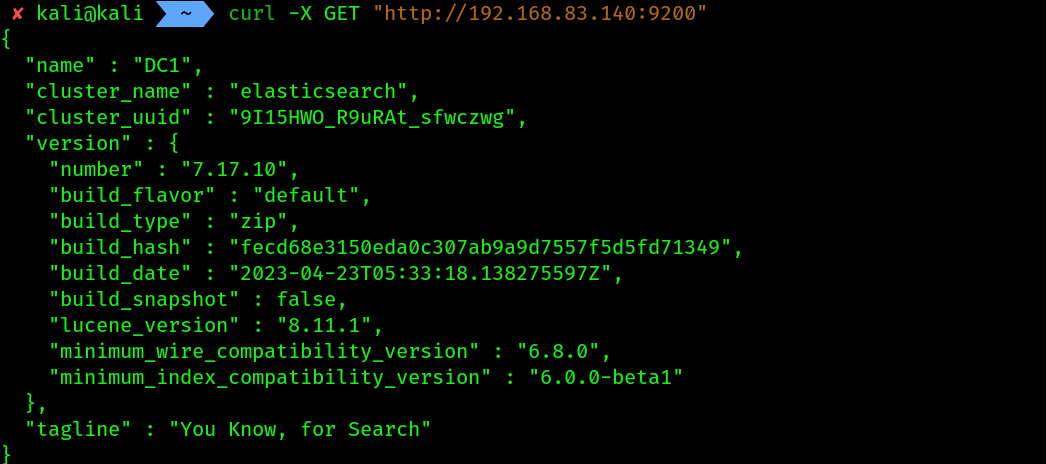
curl -X GET "http://192.168.83.140:9200"
curl -X GET "http://192.168.83.140:9200/_cat/indices?v"

_cat/indices: This is the API command to list all indices.?v: This makes the output “verbose” (shows headers), so it’s easy to read.Why it’s dangerous: This tells the attacker the names of all your databases, such as
prod-usersorcustomer-logs. EXPLANATION OF THE INFO GATHERED FROM THE FIRST COMMAND:"name" : "DC1"What it is: The node name of this specific Elasticsearch server.
Explanation: An Elasticsearch cluster can be made of many servers (nodes). You can name each one. When you started the server, it either found this name in the
elasticsearch.ymlfile or, more likely, it defaulted to using the computer’s hostname (which you’ve probably namedDC1for “Domain Controller 1”).Severity: Low. It confirms the server’s hostname, which is minor information.
"cluster_name" : "elasticsearch"
- What it is: The name of the entire group of servers (the cluster).
- Explanation: By default, if you don’t specify a cluster name in the
elasticsearch.ymlfile, it calls itself"elasticsearch". In a real company, this would be something like"prod-analytics-cluster"or"security-logs". - Severity: Low. This just confirms you’re using the default name.
"cluster_uuid" : "9I15HWO_R9uRAt_sfwczwg"
- What it is: A unique ID automatically generated for your entire cluster.
- Explanation: This ID is used internally by Elasticsearch to make sure nodes are joining the correct cluster and not a different one on the same network.
- Severity: Low. It’s just a random identifier.
"version" : { ... }
- What it is: This is a JSON object (a block of nested information) that gives extremely precise details about the software version.
- Severity: Medium. This is very useful for an attacker. Let’s break down the inside of the version object:
"number" : "7.17.10"- What it is: The exact Elasticsearch version.
- Real-World Severity: Medium-High. This is the most important piece of information here for an attacker. They will immediately take this version number and search for known, published vulnerabilities (CVEs) that affect
7.17.10. Your version is modern, so it’s not vulnerable to the old RCE exploits, but an attacker would check.
"build_flavor" : "default"- What it is: Shows you installed the standard “default” build.
- Explanation: The other option is
oss(Open Source Software), which would not include the commercial X-Pack features (like security). This confirms you have the full Elastic stack. - Severity: Low.
"build_type" : "zip"- What it is: How the software was installed.
- Explanation: This tells an attacker you downloaded the
.zipfile and ran it manually, exactly like you did. Other options would bedocker,deb(Debian), orrpm(Red Hat). - Severity: Low.
"build_hash" : "fecd68e..."- What it is: The unique code “signature” (a git commit hash) for this exact build, used by developers.
- Severity: Low.
"build_date" : "2023-04-23T..."- What it is: The exact date and time this version was compiled by the developers.
- Severity: Low.
"lucene_version" : "8.11.1"- What it is: The version of Apache Lucene that this Elasticsearch version is built on top of.
- Explanation: Lucene is the underlying search library that does all the heavy lifting (indexing and searching). Elasticsearch is the user-friendly server and API built around it.
- Severity: Low to Medium. An advanced attacker might also check for vulnerabilities in this specific Lucene version.
"minimum_wire_...andminimum_index_...- What it is: These define the oldest versions of other Elasticsearch nodes or indices that this server can communicate with.
- Severity: Low. This is for internal cluster compatibility.
- Write / Modify Data (Planting Fake Data): Since there’s no security, you can write any data you want. Let’s create a new database called
test_indexand add a “hacked” record to it.
curl -X PUT "http://192.168.83.140:9200/test_index/_doc/1" -H 'Content-Type: application/json' -d'
{
    "user": "attacker",
    "message": "This database is wide open"
}
'
PUT /test_index/_doc/1: This means “create or update document ‘1’ in the'test_index'.-H 'Content-Type: application/json': Tells the server we are sending it JSON data.-d '{...}': The actual data we are sending.- Why it’s dangerous: An attacker can modify legitimate records (like changing a user’s password) or add fake data (like a fake admin account).


- Data Exfiltration (Stealing All Data):
curl -X GET "http://192.168.83.140:9200/test_index/_search"
# another command (alternate)
curl -X GET "http://192.168.83.140:9200/test_index/_doc/1"
_search: This is the main API for searching. With no filters, it just dumps the contents.- Why it’s dangerous: This is how attackers steal millions of credit cards, user passwords, and private messages from misconfigured servers.


- Destruction (Deleting Everything):
curl -X DELETE "http://192.168.83.140:9200/test_index"
DELETE /test_index: This command permanently deletes the entiretest_index.- Why it’s dangerous: This is irreversible data loss. An attacker could run
curl -X DELETE "http://192.168.83.140:9200/_all"to delete every single database on the server.
Severity of the misconfigs:
This misconfiguration (an open database on a public IP) is considered a CRITICAL vulnerability. It’s not a complex software bug; it’s the digital equivalent of leaving your company’s entire filing cabinet unlocked on the sidewalk.
Method 1: Reconnaissance (Listing Indices)
- Command:
curl -X GET ".../_cat/indices?v" - Information Gained: A complete list of all database names (e.g.,
test_index,prod_users,customer_logs). - Real-World Severity: High
- Explanation: This is the attacker’s roadmap. They are no longer guessing. They immediately know where the “crown jewels” are.
- If they see an index named
users, they know it contains user data. - If they see
credit_card_logs, they know it’s a high-value financial target. - If they see
patient_records, they know they’ve hit a healthcare provider and can steal highly sensitive medical data (HIPAA violation).
- If they see an index named
Method 2: Write / Modify Data (Planting Fake Data)
- Command:
curl -X PUT ".../test_index/_doc/1" -d '{...}' - Information Gained: The ability to create new data or overwrite existing data.
- Real-World Severity: Critical
- Explanation: This is an attack on data integrity. The attacker can:
- Create Fake Accounts: Add a new document to the
usersindex with their own admin credentials, giving them full access to the application. - Modify Financials: Change the
balancefield in a bank’s database or alter a shipping address to steal goods. - Website Defacement: Change the text of blog posts or product descriptions stored in the database to display their own message.
- Plant Malicious Payloads: Insert data containing a script (
<script>.../script>). If a web application retrieves this data and displays it on a page without proper filtering, it could lead to XSS (Cross-Site Scripting) attacks against other users.
- Create Fake Accounts: Add a new document to the
Method 3: Data Exfiltration (Stealing All Data)
- Command:
curl -X GET ".../test_index/_search" - Information Gained: The entire contents of the database.
- Real-World Severity: Critical
- Explanation: This is the classic data breach you read about in the news. This is how millions of records are stolen.
- PII Theft: Stealing all user data (names, emails, phone numbers, addresses) for identity theft, phishing, and spam.
- Credential Theft: Stealing usernames and passwords. Even if passwords are hashed, attackers can crack weak ones offline and then take over accounts.
- Financial Theft: Stealing unencrypted credit card numbers, bank details, and transaction histories.
- Intellectual Property Theft: Stealing a company’s private business plans, source code, or internal documents.
Method 4: Destruction (Deleting Everything)
- Command:
curl -X DELETE ".../test_index" - Information Gained: N/A. The goal is pure destruction.
- Real-World Severity: Critical
- Explanation: This is a Ransomware or Denial of Service (DoS) attack.
- Ransomware: This is the most common real-world attack on open databases. The attacker:
- Runs Method 3 to download a copy of all your data.
- Runs Method 4 to delete all your original data.
- Runs Method 2 to leave a single new record in the database named
READ_MEcontaining a ransom note: “I have all your data. Pay 10 Bitcoin to this address to get it back. If you don’t, I will sell it.”
- Simple Destruction: A competitor or malicious actor simply deletes everything. If the company has no recent backups, it is instantly out of business. All user data, all product data, everything is gone forever.
- Ransomware: This is the most common real-world attack on open databases. The attacker: